Chilly

We went out around midday today while it was still dry because rain is again forecast for this afternoon.

As an aside, I have noticed this weather pattern before. In the days when Tigger was going to work, I would meet her at the end of her shift at her office. This involved me leaving home around 4 pm. Time and time again, I noticed that the weather would be dry and even sunny through the morning and early afternoon and then turn to rain just as I set out. This happened too often for it to be a case of only noticing the weather when it was bad. I conclude that London, or maybe the South East, has a pattern of dry mornings and wet afternoons. Do any meteorologists out there have anything to say about this?

Work on the power supply

Compared with recent days, it was rather chilly today. According to my weather app the temperature stood at 11° C (52° F) but with a “feels like” value of 9° C (48° F). Not exactly Arctic conditions but enough to warrant me wearing my winter coat. Once out, I was glad of it.

Rather than just make a dash for the coffee and back, we did prolong the walk by taking a turn around Myddelton Square. That’s where we saw the scene pictured above: the road has been dug up, seemingly to repair the local electricity supply.

Having called in at Myddelton’s, I was happy to make straight for home.

We had been indoors for only a few minutes before the doorbell rang. We were not expecting any delivery but I pressed the door release, anyway. Investigating further, I found a parcel on the doorstep outside. It wasn’t even for us but for one of the other flats. I guessed that the delivery person had pressed all the doorbells and then legged it.

These days, delivery people, whether postal workers or private firms, tend to assume you are at home and to just ring the bell and rush off. During our walk today we saw two large parcels left on someone’s doorstep. The delivery person had cunningly hidden these from potential thieves by placing a rather small rubbish bag in front of then. Good thinking, Batman!

Along St John Street

Today is another dull grey and damp day. We went out earlier than usual in order to avoid the rain that was forecast for later. Despite the weather, the streets were fairly busy.

Daring blackbird
Daring blackbird
Photo by Tigger

We took a stroll down St John Street and one of the first notable sights was this blackbird. He was perched right here on the pavement chirping his defiance of passers-by. We were able to approach within a couple of paces of him without disturbing his aplomb.This is another indication of how the wildlife is responding to the lockdown with increased boldness.

Sainsbury's Local ooen for business
Sainsbury’s Local open for business

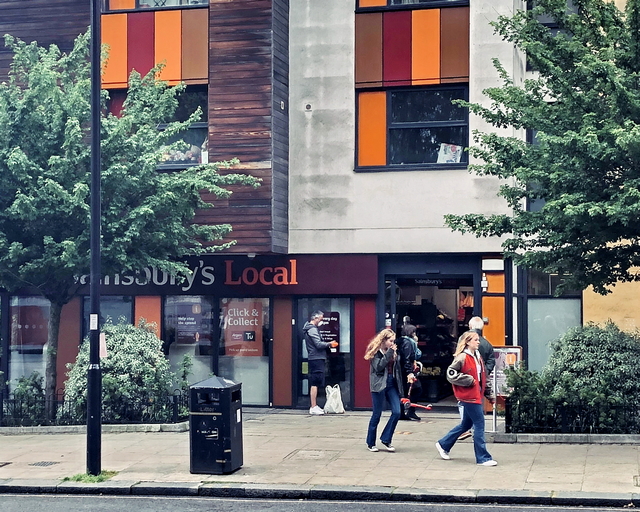
This branch of Sainsbury’s Local was open and doing a busy trade. It wasn’t obvious whether people were trying to keep to the distancing. rules In any case, in shops like this, the shelves are set so close together that it is practically impossible to do so.

Entrance, City University

We passed in front of the St John Street campus of the City University. The place was locked up tight, as you might expect. I imagine it will be quite some time before it once again opens its doors to its students.

Finsbury Library
Finsbury Library

Opposite is the local branch of the public library and local history museum. Members with an Internet connection can borrow ebooks from the library but, by the same token, many will have found other sources of books both to buy and to download free from sites such as Gutenberg and EpubBooks. The public libraries were already having to reinvent themselves in the Internet era and it remains to be seen how much damage a prolonged closure will do to them.

Shops and launderette

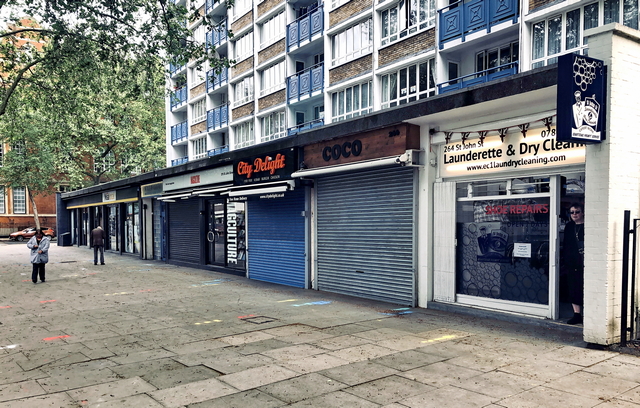
In this small shopping precinct, only two establishments were open, a Nisa supermarket (at the far end) and the launderette. These are being allowed to continue operating during the lockdown.

This was the terminus of today’s walk and from here we retraced our steps.

Barber's with rotating sign
Barber’s with rotating sign

I noticed this barber’s shop because, although it was closed, its stripey sign was rotating. In normal times this would only be the case if the establishment were open. Did they leave it on by accident or did they set it going on purpose as a sign of hope for the future?

Danger: Men at work!

Building work has been allowed to continue during the lockdown as evidenced by this small construction site. There were just two men working.

At the Angel crossroads

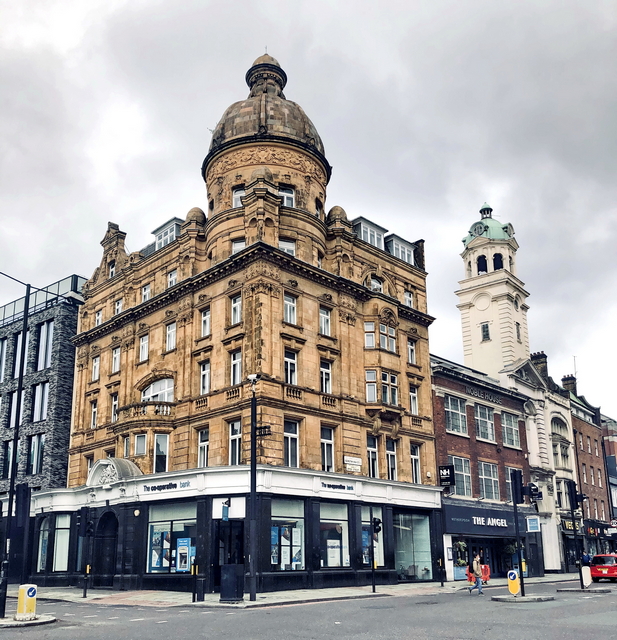
We paused at the Angel crossroads where I once again photographed our favourite local building with its doomed tower. Beside it is another tower which may once have held a bell… or possibly not. (I must remember to try to find out!)

Traffic
Traffic

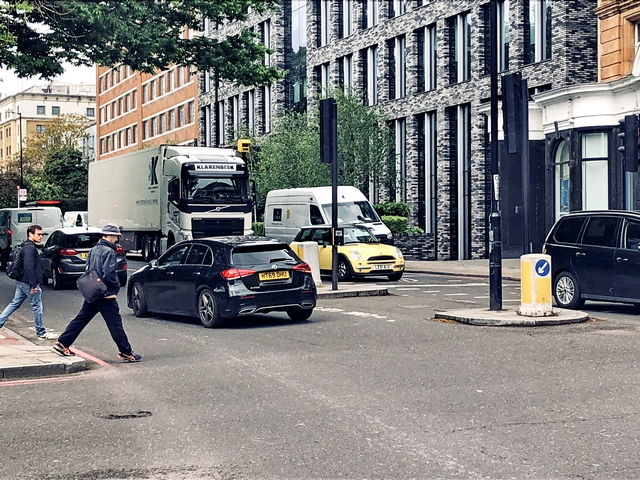
I took the preceding photo while the ltraffic lights were red. When they changed there was a busy rush of traffic both vehicular and pedestrian. It’s impossible to know whether all these folk are making “necessary journeys”.

Jusaka, open for takeaways

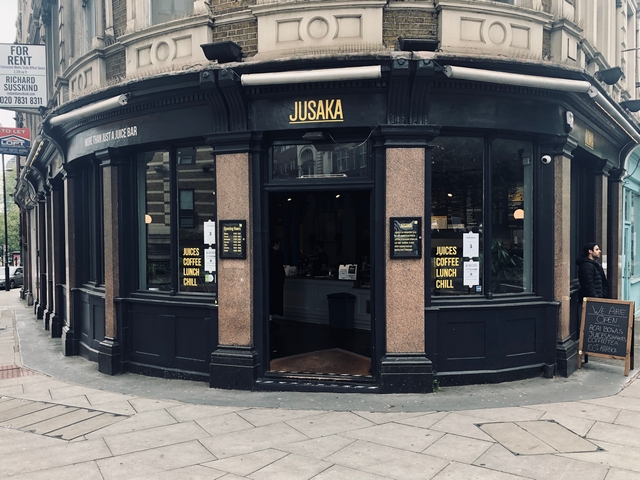
As I previously mentiond (see Jusaka reopens!) our friends at the Jusaka juice and coffee bar have reopened but for takeaway trade only. So we bought our coffee here today before turning for home.

Update

The second tower or turret in the photo entitled At the Angel crossroads belongs to the old Angel Picture House which opened in 1913 and closed in 1972. A very informative article on its history will be found here: The Angel Picture Theatre, 7 Islington High Street, Islington.

As far as I can tell, the tower never held a bell!

Damp and grey

The weather has broken at last. Then again, this was only to be expected: this is Britain, after all.

I discovered it was raining earlier this morning when I went to put out the recycling. I didn’t check the weather first and was wearing only a jacket and slippers over my sleeping clothes. In this garb I walked straight out into a rain shower and puddles!

Mylne Street
Mylne Street

This afternoon, we went out for exercise and our usual visit to Myddelton’s. On the way I took the above photo, looking down Mylne Street with St Mark’s Church in the background. You can see how grey, damp and unappealing it is!

The Off-Licence in Amwell Street

We crossed through Claremont Square into Amwell Street. On the corner of Amwell Street and Inglebert Street stands the off licence. It has always specialized, as the name suggests, in drinks but sells enough food products for it to remain open during lockdown. I have so far never stepped inside.

While Tigger negotiated the purchase of coffee, I stood outside the deli, taking in the scenery, as is my wont.

Lloyd Baker Street
Lloyd Baker Street

Myddelton’s is on a corner of Amwell Street with Lloyd Baker Street which you can see in the above photo. You might wonder whether the “Lloyd” in the name of Lloyd Baker Street has anything to do with the “Lloyd” of Lloyd and Son’s Dairy on the opposite corner. (See A few spots of rain.) As far as I know, the answer is no. Its name derives from the fact that it runs along one edge of the Lloyd Baker Estate.

It seems that in the late 17th century, land that had belonged to the Knights Hospitallers came into the possession of a Dr William Lloyd, then Bishop of St Asaph. At one point, the good bishop was committed to the Tower but survived, being acquitted at his subsequent trial. In 1775, his grand-daughter Mary married a vicar named William Baker, the estate being part of her dowry. Thereafter it became known as the Lloyd Baker Estate and conferred its name on this street.

The rain has cooled things down and today’s temperature stands at a meagre 8° C (46.4° F or 281.15 kelvin) which, according to my weather app, “Feels like 6°” (42.8° F or 279.15 kelvin). My “spring and autumn jacket” has had to be replaced with my winter coat. According to the meteorologists, we can expect a week of this unpleasant cold dampness.

Just as well we are not planning on taking any trips, eh?

And along came Kelvin…

In my recent post Fahrenheit and Celsius, I concentrated on the relationship between these two temperature scales and how to convert from one to the other. Then a reader made a comment that introduced the Kelvin scale. This set me thinking about the origin of these various scales and so I of course looked them up on the Internet. In case you are interested in what I discovered, here is an outline of my findings.

For such uses as weather and domestic temperatures, Fahrenheit is still popular in the US and certain other parts of the world but Celsius (also known as centigrade, with either a ‘c’ or a ‘C’) is now the most widely used.

The Fahrenheit scale was devised by the German physicist Daniel Gabriel Fahrenheit (1686–1736). You can tell that he was a scientist and not a layperson by the way he chose the foundation points for his scale.

He set the zero point as follows (I am quoting from Wikipedia’s Fahrenheit scale): “The lowest temperature was achieved by preparing a frigorific mixture of ice, water, and a salt (“ammonium chloride or even sea salt”), and waiting for the eutectic system to reach equilibrium temperature. The thermometer then was placed into the mixture and the liquid in the thermometer allowed to descend to its lowest point. The thermometer’s reading there was taken as 0° F.”

Fahrenheit then chose 30° for the temperature of the freezing point of water and 90° for the normal temperature of the human body. However, as he had already selected 212° as the boiling point of water, the other two had to be revised to 32° and 98.6°, respectively.

I am tempted to say that commmon sense came back into the picture at the hands of Swedish astronomer Anders Celsius (1701–1744). He chose 0° C for the freezing point of water and 100° C for its boiling point. Beyond that, there is not much to say about the Celsius or centigrade scale: it is simple and elegant.

There the matter might have rested (and for most folks, it still rests) but for William Thomson, 1st Baron Kelvin (1824–1907). Kelvin’s idea was to set the zero point at the lowest possible temperature, commonly referred to as absolute zero. The second calibration point was set at what is called the triple point of water, that is, the temperature at which water can exist simultaneously in a solid, liquid and vaporous state. The number he placed on that was 273.16. The exact definition of absolute zero is quite technical and I will not attempt to reproduce it. You will find a description in numerous sources online, including Wikepedia’s Kelvin.

I will just point out that one does not speak of “degrees kelvin” but simply of “kelvin” (small initial letter). Thus water freezes at 273.15 kelvin and boils at 373.15 kelvin. The difference between freezing and boiling is 100, as it is on the Celsius scale.

Monday and lundi

We have already discussed the origin of the names of Saturday, samedi, and Sunday, dimanche, and these are in fact the most complex of the seven day names. The remaining seven are relatively simple, being named after gods or the planets that represent those gods.

In all of the languages previously cited, the day following Sunday is dedicated to the moon. As a reminder, here is a chart of the names of Monday in all those languages:

English Babylonian Anglo-Saxon Latin French
MondaySinMonandægdies lunaelundi

The Romans named this day after the moon, whose name in Latin is luna. This is a feminine noun and the genitvie (possessive) form is therefore lunae, giving dies lunae or lunae dies, “day of the moon”, as the day name in Latin. (The Babylonian Sin is also feminine.)

In Vulgar Latin, the Latin spoken by ordinary people in France, this “correct” Latin phrase mutated into lunis dies, perhaps because the genitive forms of the names of the other gods/planets also ended in -is, for example martis dies, the day named after the god/planet Mars.

As time passed, the speech of the people gradually evolved into new forms and the exact syntax of the day names ceased to be important. Thus lunis dies changed into various forms such as lunedi and the modern lundi.

The Germanic and Scandinavian peoples frollowed the Roman pattern of day names except that they replaced the Roman gods with their own. The moon, of course, was common to all of these cultures. In Anglo-Saxon, the word for moon has two forms, mona and mone which are masculine and feminine, respectively. However, their genitive forms coincide as monan. Thus this day was known to the Anglo-Saxons as Monandæg which happens to be a word-for-word translation of the Latin lunae dies.

In Middle English, the word became Monedai (‘g’ in Anglo-Saxon was often pronounced like a modern ‘y’) and this eventually mutated into the modern Monday whose meaning “moon day” is still easy to see.